

Skills gaps, siloed thinking, and rapid change challenge Health and Life Sciences organisations. Self-driven learning, networked thinking, and connecting diverse perspectives can help overcome this and prepare for the future of work.
We’re facing arguably one of the most turbulent and unpredictable moments in recent history, impacted by multiple disruptive forces, like AI, hybrid working, and unstable geopolitics.
In this rapidly shifting mosaic of change, it’s vital that both companies and individuals strengthen the ability of their people to navigate these complexities.
Unfortunately, the reality for healthcare and life sciences companies is very different.
In the Future of Work in Healthcare and Life Sciences report, undertaken by Hunton Executive in 2025, respondents overwhelmingly identified a skills gap. Around 75% of those surveyed report at least a moderate skill gap, and about 30% rated this gap as large or very large.
According to Reanna Brown, a practicing academic futurist, this is a concern.
“We aren’t getting the skilled graduates that we need, and at the same time, university degrees are losing their efficacy with young graduates seeing the lowest rates of entry level employment.”
The thought bubble problem
But this gap isn’t only about capability but about mindset. The Future of Work report revealed that many people approach their own development infrequently, with almost half of people only addressing their own development quarterly or even annually. This might, however, be another response to the prevailing atmosphere of uncertainty, says Andrea Croft, Founder and Business Psychologist at Anaura Consulting.
With roles and required capabilities evolving so quickly, success increasingly depends on the speed of adaptation, however for many the relentless demands of their daily work can be all consuming. This, coupled with deep uncertainty as to the shape of the future, may be paralysing people when it comes to their own skills development, or even inhibiting their ability to spot external signals of change.
” Fostering expansive thinking that welcomes diverse perspectives, questions assumptions, and stays attuned to emerging trends is essential,” Andrea says.
This is especially important as this kind of thinking may run counter to many of the structural and cognitive habits that dominate modern work.
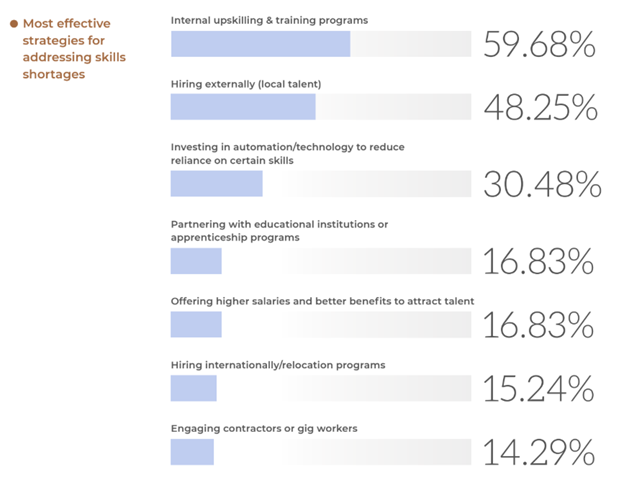
In an environment where leaders must ensure that upskilling and development pathways remain relevant, Katrina Symons, CEO and Founder of Out of Bounds, says organisations still treat learning as a tick box and need to take more responsibility for including learning as part of the everyday for employees.
She says the strongest learning programs combine stretch opportunities, external perspectives, and reflection spaces outside of the day-to-day. They also treat the learning environment as a core design variable, not an afterthought.
Changing our thinking
Closing skill gaps isn’t just about better training programs but also requires a new way of thinking. To navigate complexity, leaders must move beyond linear, siloed approaches.
One powerful tool for this is networked thinking.
Symbolic thought, where images or language are used to represent factors in a real problem or situation, is generally agreed to be a uniquely human cognitive superpower granted to us by evolution[1]. This powerful tool does, however, have its limitations, and can often fail in the face of large, abstract complexities[2], by limiting us to linear patterns of thought in complex environments, or confining us to siloed ‘islands of knowledge’.
Networked thinking offers a more effective alternative. Rather than relying on step-by-step logic alone, it emphasises connections between people, disciplines, and ideas. Research[3] in both science and education shows that networked approaches are far better at tackling big, complex problems, because they draw on diverse inputs and reveal patterns that isolated thinking misses.
There are three simple ways we can begin applying networked thinking to the problems of planning for the future of work.
[1] https://pmc.ncbi.nlm.nih.gov/articles/PMC11570560/
[2] https://www.scientificamerican.com/blog/guest-blog/how-networks-are-revolutionizing-scientific-and-maybe-human-thought/
[3] https://www.irrodl.org/index.php/irrodl/article/view/2158/3343 & https://www.mdpi.com/2227-7102/9/4/287
Leaving our knowledge islands
One of the defining features of the health and life sciences industry is specialisation. So many functions within the industry require deep specialised knowledge, and this can colour the types of individual and organisational thinking that become embedded in so many companies. While specialisation is not a bug, but a necessary and valuable feature, a side effect can be resistance to diverse inputs. This can be seen in everything from companies operating in functional silos to a resistance to hiring those from out-of-industry.
One key change the industry can make is to encourage people to leave their specific ‘island of knowledge’ – whether that’s regulatory affairs, clinical development or commercialisation – and seek cases and solutions from elsewhere in the organisation, industry, or from other industries. If, for example, we’re trying to understand the future of talent acquisition under the twin impacts of AI and automation in life sciences, then a highly effective approach might be to look more closely at movements within the world of technology.
Organisational psychologist Andrea Croft recommends leaders spend “more time externally focused and listening to patterns and what’s going on”. This way, she says, companies can “be more aware and ahead of the game in terms of what capabilities are needed, so they can jump on them sooner”.
Looking within
Another great way to apply networked thinking is to take an inventory of what we already have. For example, a simple org chart view of a company will reveal that it has so many people working across different functions, a networked thinking model might decide to look a little deeper.
By prioritising the nodes that exist within our own networks, and specifically seeking deeper information on them, we may well discover that one of the regulatory team spends most of their spare time playing with AI models, or that one of the market access experts has a passionate interest in futurism.
Another advantage of this approach is that it tends to boost internal communication and foster a commitment to learning throughout the whole organisation.
Because as Katrina says, development must be a daily habit, not a one-off workshop.
“Until every employee sees learning as self-driven, not top-down, capability gaps will stay open. Shared language can help create a culture of growth — simple one-to-one questions like ‘What did you learn?’ or ‘What do you still need to learn?’ keep development front of mind.”
Mobilising diverse perspectives
Another key aspect of networked thinking is transitive reasoning. Consider Nokia: once a paper mill, then a rubber boot manufacturer, later a phone company, and today a global telecoms provider. Its story isn’t about products, but about the ability to continually adapt.
For life sciences and healthcare, the parallel is clear. The industry’s core strength is not any single service, therapy, device, or technology, but its ability to turn science into solutions for human health. Just as Nokia continually redefined what business it was in, organisations must see themselves not only as drug or device makers, but as problem-solvers in a broader health ecosystem where data, AI, and digital platforms are becoming as important as molecules.
Conclusion
The future of work in Health and Life Sciences is defined by rapid change, uncertainty, and complex challenges. Skills gaps and siloed thinking leave organisations vulnerable, while a lack of self-directed learning can stall individual and organisational growth.
The solution lies in fostering a culture where learning is continuous and self-driven, and where networked thinking connects people, knowledge, and perspectives across silos. By deliberately leaving knowledge islands, mapping internal talent, and drawing lessons from diverse and even unexpected sources, organisations can better anticipate change, upskill effectively, and build resilience.
In short, the companies that embrace both adaptive learning and networked thinking will not only bridge today’s skills gaps but will be far better equipped to thrive in the uncertain world of tomorrow.
To read more critical insights on how industry leaders are preparing for the future of work, download Hunton Executive’s Future of Work in Healthcare and Life Sciences report here.