

Middle managers sit at the heart of every organisation, yet new research reveals a widening gap between their priorities and those of executives. Without more support this misalignment could undermine both leadership pipelines and long-term performance.
One striking trend in the Health and Life Sciences industry is a growing disconnect between middle managers and their executives. This is problematic for leadership and development pipelines, as well as hazardous for an increasingly burnt-out workforce.
Hunton Executive recently undertook the Future of Work in Healthcare and Life Sciences Report, a wide-ranging survey on the perceptions of industry participants that also drew on the analysis of industry leaders and experts in their fields.
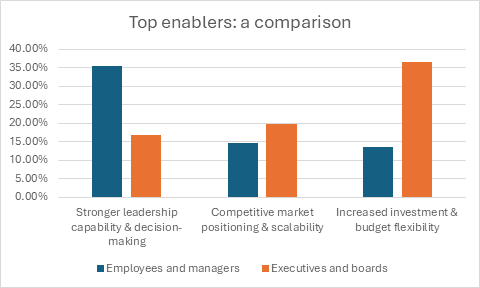
One of the most salient findings was a stark disconnect between what middle managers saw as priorities for future enablement as well as leadership development, versus what top executives identified as most important. Where more than a third of middle managers surveyed identified stronger leadership capability and decision-making as a key enabler for their company’s future, only 17% of executives agreed. Instead, nearly 37% of executives identified increased investment and budget flexibility as the top enabler, as opposed to just 14% of middle managers.
Of course, in some ways it makes perfect sense that middle managers, disconnected from higher levels of executive leadership, and faced with the daily challenges of people leadership and operations, might begin to diverge significantly from the more market driven and strategic decisions of senior executives.
However, it’s important to recognise the issues that this disconnect brings up. As one survey respondent commented: “Executive leadership have strong and clear goals and have communicated a clear plan to long-term success, but the senior and middle leadership bands lack the required skills to get us there”.
Why must we support managers?
A recent report by the Grossman Group[1], found that managers have about the same effect on an employee’s health and wellbeing as a spouse or partner. In light of this, it almost goes without saying that every company should have, as one of its highest priorities, the creation of a middle management stream that’s healthy, happy, engaged, and on a clear pathway to future development and advancement.
Andrea Croft, Director and Business Psychologist at Anaura Consulting agrees middle managers occupy one of the most critical and challenging roles within any organisation. They sit at the intersection between executive leadership and frontline teams, translating strategy into action and bridging the gap between operational realities and executive perception. This connective function is essential to ensuring alignment between organisational vision and day-to-day execution.
Yet middle managers are often under-supported, tasked with driving performance and change while burdened with competing demands from above and below. They’re expected to navigate uncertainty, lead through complexity, and maintain trust and communication across layers, often without the tools, capability, or development they need.
[1]https://www.yourthoughtpartner.com/hubfs/pdf/WellBeing_Research_White_Paper_Burned_Out_Checked_Out_FINAL_04102024_The_Grossman_Group.pdf
Leaders supporting managers
So if there is a disconnect between frontline managers and senior managers and lack of communication and trust, then how do we solve this? The first solution is top-down support. This means senior leaders must better understand how to support their managers.
“Good leadership development plays a fundamental role here, because it is all about building the capability of the organisation as a whole to navigate uncertainty and adapt to a changing environment,” says Andrea.
As this article in Psychology Today[1] explains, this can mean:
- Offering managers more recognition to celebrate their achievements
- Providing them with fit-for-purpose development and resources to succeed
- Actively seeking their input in decision-making processes to ensure their expertise is utilised
In fact, according to Kiddy & Partners[2], manager wellbeing can be increased by 32% through development but also personalised support from someone who actively encourages their development.
[1] https://www.psychologytoday.com/us/blog/our-invisible-work/202501/the-silent-force-why-middle-managers-matter
[2] https://gateleyplc.com/insight/article/the-middle-manager-crisis-why-ignoring-this-group-will-cost-you/
Developing an adaptive mindset
Meanwhile, Andrea points out, much of the problem lies in the dichotomy between adaptive and systematic management philosophies.
Through no fault of their own, many managers are stuck in an overly simplistic paradigm of problem solving versus adaptive approaches that are needed today.
Do we have a problem with communications in our company? Then let’s buy and install new comms software. Are we faced with a hybrid workforce that’s flagging in productivity? Then let’s just add multiple layers of employee surveillance tools.
The issue with purely systematic approaches is that they tend to be overly reductive and can often lead to ‘solutions’ that simply add another layer of problems, thus alienating both the staff who are subjected to them, as well as the crucial middle managers who are required to implement them.
“In more predictable times, leaders could provide direction or source an expert to solve difficult problems – there was an answer, they just needed to find it. Whereas in today’s world, we don’t know even what the problem is, let alone if there’s an answer. There’s no playbook for this,” Andrea says.
Rather than trying to fit a single technical or systems solution into an existing paradigm, adaptive solutions address the paradigms themselves. A good example is hybrid working, which has emerged as a key issue since the pandemic. Where many companies have taken a systematic approach, either attempting to remove or limit hybrid work outright, or addressing its challenges with a scattergun collection of tools and technologies, adaptive managers have taken a more effective approach by understanding the complexities of the challenge and the different perspectives of all involved.
Therefore, a way to make the job of a manager easier is to develop their capacity in adaptive problem-solving, Andrea says.
This means creating a strong leadership development pipeline, as well as investing meaningfully in the creation of professional development programs that will equip managers with adaptive capability and resilience to change. Additionally, senior executives should also be taught to lead adaptively, thus strengthening links between themselves and frontline managers, and creating greater unanimity around strategic goals and decisions.
In a practical sense, this means companies need to shift from tools-based development approaches to expanding people’s capacity to address new and complex problems. This could involve vertical leadership development, which a study[1] conducted across multiple organisations found can prepare leaders for the volatile, uncertain, complex, and ambiguous world – if there is personal and organisational commitment.
“The traditional model of leadership development is horizontal. If we think about a leader represented by a cup, it’s about filling the cup with skills; how to influence, manage stakeholders, conduct a performance review and so on,” Andrea says.
“Vertical development, on the other hand, is focused on growing the cup. It’s about how to help a leader be capable of much more. It’s about developing their capacity to think differently, and to navigate ambiguity and complexity. It is helping them to transform their mindset so they can meet the adaptive challenges in front of them.”
[1] https://scholar.valpo.edu/jvbl/vol13/iss1/8/
Focusing on wellbeing
The role of a middle manager is complex and arduous. They act as a link between the strategic decisions of senior executives and frontline staff and their daily challenges. It’s unsurprising, then, that burnout in managers is reported at 63%[1].
It’s clear that if a majority of middle managers are burnt out, then this will have clear and significant impacts on the companies that employ them. Burnout leads to absenteeism and staff turnover, which results in crucial losses in terms of human capital, corporate knowledge, and productivity.
This is ironic, given that one of the key drivers of burnout is the prioritisation of productivity and performance over health and wellbeing. And of course, burnt out middle managers are more likely to miss burnout in their staff, which can create a cascade of costs and losses.
One obvious solution to this problem is a greater focus on staff health and wellbeing. In the Future of Work Report, practicing futurist Reanna Brown pointed out that around 50% of the workforce is living with chronic health condition, be that physical injury or mental health[2]. This is a staggering figure, and one which needs to loom large in any company’s calculations around securing the future of their workforce.
With the increase of burnout in key staff segments, the prevalence of chronic health issues, and the rapid and constant pace of change, companies that prioritise staff wellbeing will have a competitive edge. This advantage will be felt not just as a driver of productivity, but also as one of the most important employee value propositions in terms of attracting and retaining top talent.
It’s clear that one of the most important challenges facing the industry today is the nurturing and development of its middle managers and future leaders. One of the key aspects of this is the immense pressures placed upon middle managers, which will in turn rebound on the people whom they manage.
Organisations that prioritise supporting their managers from the top down, invest appropriately in their development as adaptive future leaders, and protect them from burnout are sure to have a competitive edge, no matter what the future brings.
To read more critical insights on how industry leaders are preparing for the future of work, download Hunton Executive’s Future of Work in Healthcare and Life Sciences report here.
[1] https://www.yourthoughtpartner.com/hubfs/pdf/Well-Being_Research_White_Paper_Burned_Out_Checked_Out_FINAL_04102024_The_Grossman_Group.pdf
[2] https://www.aihw.gov.au/reports/australias-health/chronic-conditions