

Analysis of current conditions in the labour force shows that the most compelling employee value proposition may come from a surprising but fundamental area – employee health.
In a recent survey of around 300 people working in healthcare and life sciences, around 1/3 reported their organisational culture as only ‘moderately healthy’. Some said it was not healthy at all.
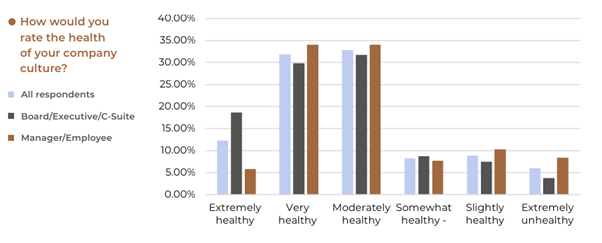
Yet according to the survey, published in Hunton Executive’s Future of Work in Healthcare and Lifesciences report, approximately half of respondents, across all age groups, say that company culture is a primary motivator for staying with an organisation long term.
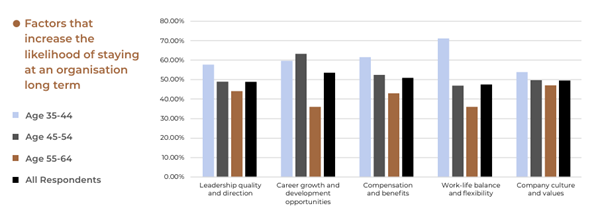
This focus on the healthiness of a company’s culture may contain deeper lessons about staff retention. When we consider the implications of the survey data, in conjunction with broader trends in the workforce, it strongly suggests that several key factors underpin the centrality of healthy workplace culture as a factor in retention.
Winds of change
Reanna Browne is an academically trained and practising futurist and founder of the organisation, Work Futures. She spends her days analysing workforce trends and understanding how current changes will shape future work.
For Reanna, perhaps the biggest blind spot facing organisations is the emergence of the unwell workforce. In recent times, over half of the population has fallen prey to long-term illness[1], an alarming statistic that’s sure to have significant impacts on all aspects of employment and retention.
“If 50% of the workforce is unwell in some way, be it chronic illness or mental health, what does that mean for how we attract talent? What does it mean to be ‘fit for work’? How do we design jobs and recruitment differently? What assumptions about our workforce characteristics have we baked into our practices, programs and decisions today? And what might we adapt in response to these changes?”
“The future is shaped by what we do and don’t do today, not in 10 years,” she says.
It seems clear from these data that companies can no longer afford to view workplace health as an ancillary consideration. Health at work is fast becoming a structural necessity, a key strategic pillar, and a potential competitive advantage.
[1] https://www.aihw.gov.au/reports/australias-health/chronic-conditions
Recognising systemic health risks
Reanna says the health conversation is already heading into systemic risk territory. “We’re seeing a rise in psychosocial risks linked to financial stress, job insecurity, and AI reshaping how people feel about their roles. Precarity is becoming normalised, and it’s making people unwell.”
The manifold stresses of precarity are having a significant impact on employee health, and in many cases, baked-in corporate reflexes are worsening the problem. For example, research from Stanford University[1] found that layoffs in the tech industry had no real strategic basis but were instead a form of “social contagion”, with companies engaging in mindless copycat behaviour.
Layoffs such as these have a ripple effect, weakening not just the companies concerned, but degrading confidence throughout the entire workforce. For employees with less than stellar faith in their company’s culture and practices, the impacts of heightened anxiety can be very severe indeed. Increases in stress levels are well known to cause health problems, and somewhat soberingly, the stress associated with scatter-fire layoffs can double the risk of suicide.
Reanna says that’s why it is compelling when a company takes a public stand. When Nintendo’s CEO took a pay cut to prevent layoffs, the incident went viral[2], suggesting that people throughout the workforce are paying close attention to corporate behaviour, and that these behaviours can directly impact our sense of security and general state of mind.
This insight becomes sharply relevant when we think about systemic health factors as they relate to company culture. Executive decision making and company culture have a clear impact on employee happiness and therefore health, and companies must look closely at these factors to address the systemic risks associated with precarity and poor morale.
[1] https://stanfordmag.org/contents/the-loop-december-13-2022
[2] https://www.cnbc.com/2024/02/13/nintendo-ceo-once-halved-salary-to-prevent-layoffs-why-thats-uncommon.html
The impact of surveillance
Reanna also wants to sound the alarm about another quiet disruptor, this being the corrosive impact of algorithmic management and surveillance.
“There are more than 500 workforce tools out there now, ushered in during the pandemic. If you’ve got Microsoft Teams, you’ve already got surveillance. You’ve got performance tracking, recruitment filters, online monitoring.”
She warns that the rise of this “bossware” and algorithmic oversight is significantly degrading trust and health inside workplaces.
“Some studies show that the more surveillance is in place, the more likely workers are to make mistakes or even sabotage,” she says. In a recent inquiry into workplace surveillance conducted by an Australian government[1], it was reported that a meta-analysis of over 90 independent studies showed workplace surveillance, far from being helpful, either had no impact on productivity and performance, or was actively counterproductive.
Combined with this, the same report stated that the health and wellbeing impacts were devastating, with many respondents testifying to such intense anxiety, and such overbearing use of surveillance, that they were forced to leave employment.
The advent of workplace surveillance has been insidious partly because of its gradual nature, resulting in a situation where some workers are now being monitored to such an extent that simply looking away from their computer screens will trigger an alert.
With all this, it should come as no surprise that Reanna has found that the workforce in general is deeply stressed and severely overstretched. It isn’t difficult to draw a correlation between these working conditions and the sudden explosion of work-related illness.
[1] https://www.parliament.vic.gov.au/inquiryintoworkplacesurveillance
What can companies do?
In light of compelling evidence of the increasing centrality of health as an emerging and vital employee value proposition, companies who want an edge in retention should focus on key aspects of employee health and welfare.
Awareness: It’s not enough to simply recognise that staff may be a little unhappy or stressed. Companies need to examine their 360° feedback systems or create them if they don’t currently exist, in order to gain a detailed and comprehensive understanding of employee wellbeing. This clear understanding of the nature and extent of the problem is vital to the creation of effective strategies to deal with it.
Surveillance: Some workplace surveillance is of course essential, especially when it comes to meeting requirements around safety and governance. Companies should, however, carefully examine their full suite of tools with an eye to determining which of these are actually helpful, and which are unnecessary and counterproductive. This is important, as many organisations will be using surveillance tools that they may not be fully aware of, but which their staff interact with daily, potentially causing stress and burnout.
Demographics: It may sound like a truism, but it’s important for companies to know who their workforce actually is. Reanna cites an example of one organisation who, upon conducting a survey of its staff, suddenly discovered that a third consisted of women aged between 40 and 60. This insight drastically reshaped what catering for employee health and wellbeing meant for them, as well as creating cascading changes in recruitment and succession planning.
Innovation: Some companies have already begun responding to the growing phenomenon of the unwell workforce. There are instances of organisations founding dedicated clinics for their staff or making structural changes in order to hold a space especially for women’s health. Companies should look to the broader marketplace to uncover key innovations that can improve employee health and wellbeing.
Culture and Leadership: It’s clear that executive actions and the overall culture of an organisation has a profound impact on employee health and wellbeing. Companies should take a careful audit of their internal culture, identifying practices and behaviours that increase stress levels or the sense of precarity, and work in a collaborative way to mitigate or eliminate these stressors.
Conclusion
It would seem that workers are responding to quiet but inexorable increases in the stress and precariousness of employment by becoming unwell. When we consider this decline in employee health as a broad trend related to the impacts of social and technological factors on the labour force, it becomes clear that employee health must be placed front and centre in any retention strategy. Employers who are willing and able to take steps to protect their staff from the manifold stresses of contemporary work will potentially end up wielding the most compelling employee value proposition within the future labour market.