

Automation was meant to streamline recruitment. Instead, employers are overwhelmed with a tsunami of applications, while inflexible algorithms devastate the pool of available talent. As confidence drops, organisations must adapt to attract top talent.
Challenges around attracting top talent have become a matter of urgency for many organisations today, even as confidence in their ability to do so wavers. In spite, or perhaps because of the rapid rise in automation, AI tools, and digital recruitment platforms, a pessimism seems to have infused the landscape around hiring.
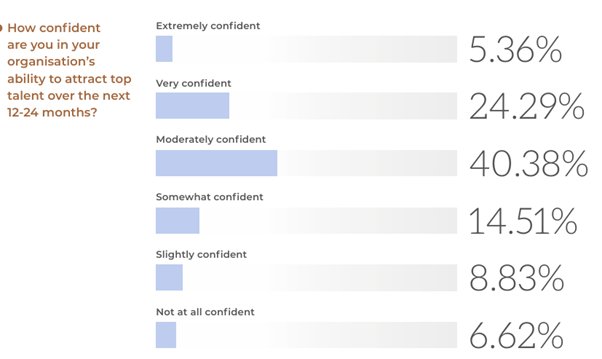
According to Hunton Executive’s Future of Work in Healthcare and Life Sciences report, fewer than a third of respondents (29.65%) say they are “very” or “extremely” confident in their organisation’s ability to attract top talent over the next 12 to 24 months. The majority (40.38%) are only “moderately” confident, while nearly 30% admit to having low or no confidence at all.
When solutions create problems
Many HR professionals hailed the advent of automated tools as the solution to problems of scale in recruitment. Technologies like resume screeners and AI powered psychometric testers promised to reduce transactional task loading and eliminate human error and unconscious bias.
According to academically trained and practising futurist Reanna Browne of Work Futures, however, these tools are now part of the problem. Candidates have responded to the automated screening by flooding the zone with applications. Reporting from The New York Times[1] revealed a more than 45% surge in LinkedIn applications in the past year, clocking a staggering average of 11,000 applications per minute. With numbers like this, some HR professionals are actually reporting a rise in routine transactional tasking.
On the other end, hiring platforms filter candidates based on rigid keyword-matching, eliminating nuance and missing people with the right mindset or adjacent skills. In response, candidates concerned about their applications being discarded before they ever reach a human, are turning to automated tools to circumvent screening processes, unleashing a tsunami of resumes. The result is a hiring landscape that more resembles a technological arms race, and one that is increasingly transactional, devoid of human contact, and lacking in the very efficiencies these new tools seemed to promise.
Another issue is the systematic bias often embedded in AI. A 2023 study in Nature[2] showed that most datasets, unless very carefully planned and managed, will cause AI hiring tools to further entrench the exclusion of underrepresented groups. This narrowing of the talent pool makes it even more difficult to procure sufficient high-quality candidates to secure succession and recruiting pipelines.
Additionally, concerns around deepfakes, scams, and security breaches are mounting in direct correlation to the reduction of direct human intervention in hiring processes. A recent report from the Financial Times[3] showed that applicants using deepfake and AI technologies had stolen more than $500 million through siphoning accounts, stealing trade secrets, and installing ransomware.
“Our obsession with automated efficiency in hiring is creating two unintended consequences: dehumanised processes and an application tsunami,” says Reanna.
“We automate to handle scale. Candidates use AI to match it, applying to hundreds of jobs at once. So we automate again to manage the flood. Each fix becomes the next problem, and the more we solve, the further we drift from what we set out to do: to hire humans, not process them. In the end, we are breaking the very thing hiring is meant to serve: people.”
[1] https://www.nytimes.com/2025/06/21/business/dealbook/ai-job-applications.html
[2] https://www.nature.com/articles/s41599-023-02079-x#Sec14
[3]https://www.forbes.com/sites/jackkelly/2025/04/11/fake-job-seekers-are-exploiting-ai-to-scam-job-hunters-and-businesses/
Back to analogue
In response, many recruiters are going analogue again: no ads, no bots, just conversations and trusted networks. Vanessa Meikle, Hunton Executive’s CEO, says that top talent is attracted by leadership. “They come from understanding how you work, how you communicate, how you make decisions,” she says.
Vanessa says there is a need for specialist firms with access to top candidates and deep understanding of the local market to help target and influence top talent. A more targeted and strategic approach with a 12-month planning for succession and talent is also critical.
According to both Reanna and Vanessa, the organisations of the future with the best competitive edge in recruitment will be those who have successfully reintegrated human contact and interaction into their hiring processes.
Impacts on the labour market
The rapid and comprehensive change in hiring technologies has resulted in a dramatic shift in the labour market, particularly when it comes to candidate attitudes and experience. This isn’t helped by instances of bias in key technologies such as Large Language, or Massive Text Embedding Models. Recently, Forbes[1] magazine reported that a class action lawsuit against WorkDay (an HR finance company) claiming that their automated recruitment discriminated on the basis of age, had been allowed to go ahead.
This case, and others like it, resonate with findings from the University of Washington[2], who recently published an alarming study that showed deeply entrenched bias in AI models. Most notably, it found that in nearly 90% of cases, AI models favoured applicants who had typically white male names and discriminated against certain ethnicities up to 100% of the time. In an increasingly stressed hiring and retention environment, very few companies can afford reputational damage of this kind.
And it’s not just bias in AI – increasingly, candidates are expressing frustration and fear around automation in hiring practices. In a study published by the ESCP Business School[3], form the Sorbonne Alliance in France, one of the most salient findings was anxiety around the lack of transparency in automated screening processes. Candidates often feel they are operating in a hostile and trackless environment, with invisible robots making opaque decisions about their lives and futures.
This is further compounded by the proliferation of false job advertisements. In January of this year alone, Australians lost more than $4.2 million dollars to fake job ads, according to the AFP[4]. What all this adds up to is a labour market where candidates are increasingly beleaguered, uncertain whether the job they’re applying for is real, on what criteria they’ll be accepted or rejected, or if their application will ever reach an actual human. This can have a significant impact on brand and company perception, especially if an organisation’s hiring practices fit into this constellation of hostile factors.
The challenges created by recruitment automation are unfortunately coinciding with a growing skills gap. Reanna is concerned about deeper structural impacts in the labour market.
“’It’s what I call a tight and loose labour market,” she says. “Tiny pockets of highly competitive roles where companies fight over talent, while at the same time we have a growing number of people unemployed or underemployed. We’re seeing job vacancies and skill shortages rise simultaneously – it’s a market that’s both starved for talent and drowning in available workers.”
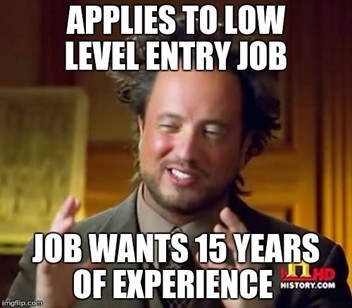
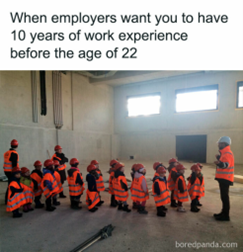
“There’s a meme going around: ‘Apply for your first job: must have 15 years’ experience,'” adds Reanna. “Memes like this aren’t just jokes, they’re viral code for workplace cynicism, compressing a generation’s frustration about work and opportunity into a single, shareable line. They circulate endlessly because they’ve become the only way people can articulate what the formal world of work won’t let them say.”
[1] https://www.forbes.com/sites/janicegassam/2025/06/23/what-the-workday-lawsuit-reveals-about-ai-bias-and-how-to-prevent-it/
[2] https://ojs.aaai.org/index.php/AIES/article/view/31748/33915
[3] https://www.sciencedirect.com/science/article/pii/S2451958823000362#sec5.2.2
[4] https://www.afp.gov.au/news-centre/media-release/unicorn-job-scams-criminals-target-vulnerable-aussies-looking-work
Automation, she argued, is compounding this problem. When hirers take the time to talk to applicants, and to make bets on the basis of genuine human contact. But in today’s leaner organisations, that time and willingness is scarce.
Is there a solution?
While the problems caused and amplified by automation might seem dire, Reanna believes progress is possible, pointing to examples of companies who are conducting full scale audits of their hiring practices to find the exact inflection points where human interaction is essential. And many companies are acting to address the skills gap as well.
“ I’m seeing some first-mover organisations reckoning with this,” she says. “IBM wants to train 30 million people, Google’s certificates have reached a million graduates, Amazon‘s investing over a billion in employee education. When companies start talking about training millions as a kind of corporate social responsibility, it suggests the traditional education system has failed to bridge the skills gap. We might be witnessing the return of corporate academies — but this time, they’re filling a void that universities left behind.”
“If HR has a seat at the table with the executive team when growth plans are being discussed, then that is the time to question whether their processes are working, and think about how they can shift it based on the talent we are looking to hire and the timelines we need to achieve them”
There’s also an opportunity to really challenge and ask tough questions here. Because digging deeper into why is where they uncover the real gaps — in mindset, in process, and in what they value.
As Charlotte Sweeney, OBE, CEO of Charlotte Sweeney Associates, says, organisations often say they want the best talent, but that statement in itself is loaded with assumptions. For example, the organisation may think the best talent is someone who has sector experience. The question then becomes why they want sector experience, and what they miss out on by making that a non-negotiable.
“I don’t accept broad statements like ‘diversity is really important to us’ without pushing further. Why is it important? How does it show up in your hiring decisions, your team dynamics, your leadership pipeline?”
For example, Charlotte recently worked with an organisation that thought they were doing well on diversity because they had a 50/50 split between men and women across most levels. However, most employees were white.
“That raises a question: is there really no issue? Or is it that you’re not attracting people from different backgrounds, not looking in the right places, or not creating an environment where they feel welcome?”
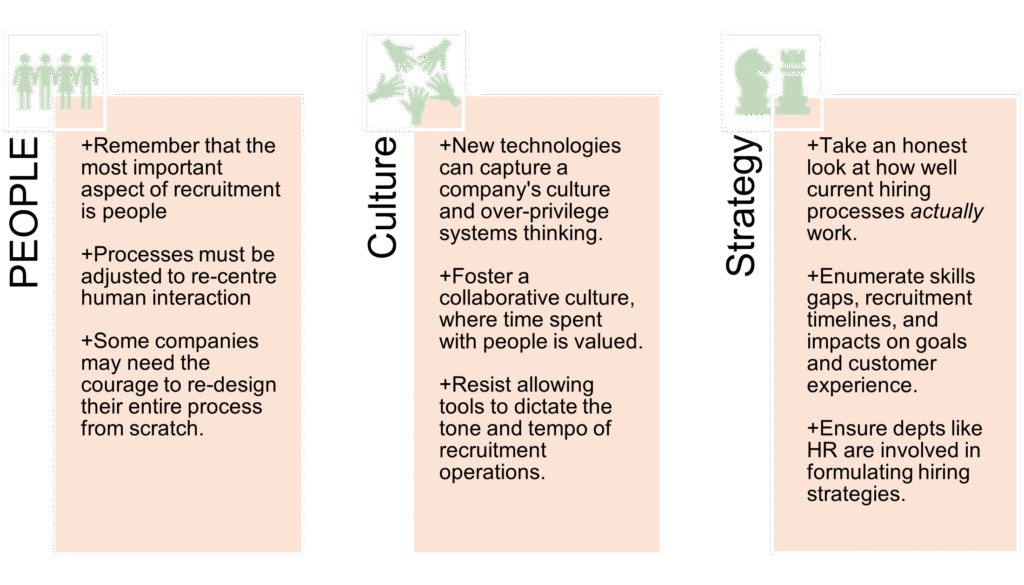
When it comes to the question of what companies can do to address some of the more corrosive effects of automation, the answers are multi-faceted and holistic in nature. Companies must formulate responses across three pillars, these being people, culture, and strategy.
.
Conclusion
It’s clear that when it comes to attracting top talent, especially given the numerous challenges facing the labour market of today, careful and adaptive approaches are required. Organisations must take steps to accurately measure how well their current hiring practices actually work, gain a full appreciation of their current capability laydown and the time they have to fill in any gaps, and think about how these factors impact on strategic goals and customer experience.
With these considerations in mind, companies should be able to shift their hiring practices in a direction that’s more human focused, while still preserving the efficiencies offered by new technologies.
Because companies able to provide a more rich and human recruiting experience are bound to have the greatest competitive advantage in the labour market of the future.